Showing posts with label Private Jet ownership. Show all posts

Tuesday, 7 May 2013

Aviation Nigeria

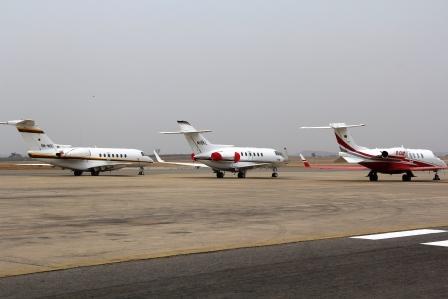
Private jets are fast and wonderfully convenient. They can access hundreds of airports throughout the world, making it possible to go places you just can’t get into on large commercial aircraft. But there is also the downside.

Many were held spell bound at the awful fate which befell former Governor of Taraba state Dan Baba Suntai. Some refer to it as an act of fate, a plan by enemies or a will of God. For others however, like professionals in the aviation industry, it is a simple case of airline safety regulation violation.

There have been a string of irregularities by airline operators as well as agencies offering aviation services. The irregularities could be trivial, such as pilgrims complaining of having their seats sold out. Or in some cases complex, like controversies on whether the responsibility for the Helicopter crash which led to the death of Governor Yakowa of Kaduna state should have been allotted to the Ministry of Aviation as against the Nigerian Navy.

In a bid to ensure coordinated safe and secure airline operations in Nigeria, the Federal Government issued the National Civil Aviation Policy, 2013. A policy which the the Federal Government maintains is designed to provide a platform for the way forward and future prospects of the aviation industry.

The policy however has caused media up-roar, especially when representatives of private jet owners like Globalcom giant Mike Adenuga, Global fleets Jimoh Ibrahim, as well as business tycoons Aliko Dangote and Harry Akande have began to scrutinize for loopholes and clauses within the policy which may result in a conflict of interests.

A key area which has requested clarification in the recent policy is a series of clauses that have been interpreted as a move by the Federal Government to ban private Jet owners from carrying friends and relatives, with requests on clarification to which a response by the Federal Government is still being anticipated.

However it must be noted that the National Civil Aviation Policy, 2013 deals with issues beyond the interests of private jet owners. Issues relating to aviation financing, aviation training and development, safety regulations, as well as liabilities arising from crashes and related occurrences were key concepts tackled in the preparation of the policy. A majority of these adjustments have become necessary in the wake of new developments in the aviation sector.

Such policies are also not new, and in most cases are not for the short-run comfort of a few but for the safety of the majority in the long run. Notable in the US are policies requiring fingerprint-based background checks on pilots, as well checking passenger names against a government watch list and restricting what items may be carried onto the airplane.

Aviation regulations are key to the proper functioning of the industry. They help agencies required to not only run more efficiently and effectively, but also cut down unnecessary risk that may lead to loss of lives. They help to solve complex issues like working out legal knots in lease agreements as well as requesting simple information such as: Where the plane is flying, air traffic control, the type of plane, the age of the plane, the experience and training of the pilots and crew, weather conditions, plane and equipment maintenance as well as company procedures and policies.

Dan Baba Suntai was a Private Jet Owner. Like many private jet owners in Nigeria, he was not operating under prescribed regulations. He was fatigued, the weather was hazardous  the flight was un-scheduled and the timing was bad. There was a breach of several regulations resulting to complications for not just the people who were in the aircraft on that fateful jet that day, but also Taraba state and Nigeria in general.

The National Civil Aviation Policy, 2013 may require further clarification by the government as well as aviation professionals who participated in its drafting, in ways that will be clearer to stakeholders. However it must remain clear that the aim of the policy lies beyond the comfort of private jet owners.

NCAP: Beyond comfort, rethinking safety of private aircraft owners

Aviation Nigeria

Private jets are fast and wonderfully convenient. They can access hundreds of airports throughout the world, making it possible to go places you just can’t get into on large commercial aircraft. But there is also the downside.

Many were held spell bound at the awful fate which befell former Governor of Taraba state Dan Baba Suntai. Some refer to it as an act of fate, a plan by enemies or a will of God. For others however, like professionals in the aviation industry, it is a simple case of airline safety regulation violation.

There have been a string of irregularities by airline operators as well as agencies offering aviation services. The irregularities could be trivial, such as pilgrims complaining of having their seats sold out. Or in some cases complex, like controversies on whether the responsibility for the Helicopter crash which led to the death of Governor Yakowa of Kaduna state should have been allotted to the Ministry of Aviation as against the Nigerian Navy.

In a bid to ensure coordinated safe and secure airline operations in Nigeria, the Federal Government issued the National Civil Aviation Policy, 2013. A policy which the the Federal Government maintains is designed to provide a platform for the way forward and future prospects of the aviation industry.

The policy however has caused media up-roar, especially when representatives of private jet owners like Globalcom giant Mike Adenuga, Global fleets Jimoh Ibrahim, as well as business tycoons Aliko Dangote and Harry Akande have began to scrutinize for loopholes and clauses within the policy which may result in a conflict of interests.

A key area which has requested clarification in the recent policy is a series of clauses that have been interpreted as a move by the Federal Government to ban private Jet owners from carrying friends and relatives, with requests on clarification to which a response by the Federal Government is still being anticipated.

However it must be noted that the National Civil Aviation Policy, 2013 deals with issues beyond the interests of private jet owners. Issues relating to aviation financing, aviation training and development, safety regulations, as well as liabilities arising from crashes and related occurrences were key concepts tackled in the preparation of the policy. A majority of these adjustments have become necessary in the wake of new developments in the aviation sector.

Such policies are also not new, and in most cases are not for the short-run comfort of a few but for the safety of the majority in the long run. Notable in the US are policies requiring fingerprint-based background checks on pilots, as well checking passenger names against a government watch list and restricting what items may be carried onto the airplane.

Aviation regulations are key to the proper functioning of the industry. They help agencies required to not only run more efficiently and effectively, but also cut down unnecessary risk that may lead to loss of lives. They help to solve complex issues like working out legal knots in lease agreements as well as requesting simple information such as: Where the plane is flying, air traffic control, the type of plane, the age of the plane, the experience and training of the pilots and crew, weather conditions, plane and equipment maintenance as well as company procedures and policies.

Dan Baba Suntai was a Private Jet Owner. Like many private jet owners in Nigeria, he was not operating under prescribed regulations. He was fatigued, the weather was hazardous  the flight was un-scheduled and the timing was bad. There was a breach of several regulations resulting to complications for not just the people who were in the aircraft on that fateful jet that day, but also Taraba state and Nigeria in general.

The National Civil Aviation Policy, 2013 may require further clarification by the government as well as aviation professionals who participated in its drafting, in ways that will be clearer to stakeholders. However it must remain clear that the aim of the policy lies beyond the comfort of private jet owners.
Thursday, 24 January 2013


Aviation Nigeria

By George Uriesi

Today’s event is of great significance because it marks the formal commencement of general aviation services at the Nnamdi Azikiwe International Airport since its inception in the early 80s, even though it is the second busiest airport in the country, after the Murtala Muhammed Airport, Ikeja. 

The airport has had to contend with decaying infrastructure and obsolete facilities that belied its position as the second busiest in the country, apart from being situated in the nation’s capital city. What was then the airport’s domestic terminal operated both scheduled and non-scheduled flights using the same tarmac and terminal facilities.

The resultant congestion did not augur well for efficient service delivery hence the need to separate the services into two terminals. Domestic flight operations were transferred to a wing of the international while the old domestic terminal was to be remodelled to serve as the General Aviation Terminal, for more efficient service delivery.

This new arrangement was made possible by the advent of airport remodelling project initiated by President Goodluck Jonathan and vigorously pursued by the Honourable Minister of Aviation, Princess Stella Adaeze Oduah, who has not relented in reminding all of us that implementing the project to the letter is a task that must be done. Today’s commissioning of this new General Aviation Terminal is a product of her relentless effort.

We are happy to inform you that the Authority is bracing up for more commissioning ceremonies in the next few months because work on the remodelling of the other terminals under phase I of the airport remodelling project is nearing completion in Benin, Owerri, Yola, Kano, Enugu, Port Harcourt, Kaduna, Calabar and Jos. 

You may also wish to recall that the reconstructed Domestic Terminal I (formerly GAT) of the Murtala Muhammed Airport, Ikeja was commissioned in October, last year.

Work on the remodelling of this new General Aviation Terminal started in October, 2010 and was completed early this month. 

The project entailed the expansion of the old domestic terminal and its conversion to a general aviation terminal for non-scheduled flights. The new terminal has a full complement of modern terminal facilities including check-in counters, shops, offices, duty rooms, conference center, dining room, kitchen, security screening machines and lounges, including a separate lounge for pilots.

By today’s commissioning, scheduled and non-scheduled flights at the Nnamdi Azikiwe International Airport will take place at two different terminals, creating opportunities for huge improvement in service delivery by FAAN and other service providers in the aviation industry. 

is our hope that the completion of the first and second phases of the airport remodelling project will transform Nigerian airports into a haven for viable private investments. We hereby invite all well meaning investors to join hands with Government to hasten the fulfilment of this dream.

We wish to thank our dear President, Dr. Goodluck Ebele Jonathan for believing in the potential of the aviation industry to make Nigeria great and for matching this belief with action, through the formulation of the Transformation Agenda for the industry. We also owe deep gratitude to the amazon of the industry, Princess Stella Adaeze Oduah for her doggedness in realising the vision of the President for the industry. 

The airport remodelling project and other programmes for the industry would have remained mere paper work without the assistance of the National Assembly which has encouraged us through their various committees on aviation. We are grateful, Your Excellency. 

We also thank other stakeholders, who have, in one way or another, made today’s event possible through their various contributions.

On our part as FAAN, we wish to assure all Nigerians, especially aviation stakeholders, that our airports can only get better. The recent restructuring of the Authority was designed to make us adapt to recent developments in the industry so that our services will not fall short of acceptable international standards, as set by ICAO and I know that this is achievable.

ABUJA GAT: A product of unwavering efforts - Uriesi


Aviation Nigeria

By George Uriesi

Today’s event is of great significance because it marks the formal commencement of general aviation services at the Nnamdi Azikiwe International Airport since its inception in the early 80s, even though it is the second busiest airport in the country, after the Murtala Muhammed Airport, Ikeja. 

The airport has had to contend with decaying infrastructure and obsolete facilities that belied its position as the second busiest in the country, apart from being situated in the nation’s capital city. What was then the airport’s domestic terminal operated both scheduled and non-scheduled flights using the same tarmac and terminal facilities.

The resultant congestion did not augur well for efficient service delivery hence the need to separate the services into two terminals. Domestic flight operations were transferred to a wing of the international while the old domestic terminal was to be remodelled to serve as the General Aviation Terminal, for more efficient service delivery.

This new arrangement was made possible by the advent of airport remodelling project initiated by President Goodluck Jonathan and vigorously pursued by the Honourable Minister of Aviation, Princess Stella Adaeze Oduah, who has not relented in reminding all of us that implementing the project to the letter is a task that must be done. Today’s commissioning of this new General Aviation Terminal is a product of her relentless effort.

We are happy to inform you that the Authority is bracing up for more commissioning ceremonies in the next few months because work on the remodelling of the other terminals under phase I of the airport remodelling project is nearing completion in Benin, Owerri, Yola, Kano, Enugu, Port Harcourt, Kaduna, Calabar and Jos. 

You may also wish to recall that the reconstructed Domestic Terminal I (formerly GAT) of the Murtala Muhammed Airport, Ikeja was commissioned in October, last year.

Work on the remodelling of this new General Aviation Terminal started in October, 2010 and was completed early this month. 

The project entailed the expansion of the old domestic terminal and its conversion to a general aviation terminal for non-scheduled flights. The new terminal has a full complement of modern terminal facilities including check-in counters, shops, offices, duty rooms, conference center, dining room, kitchen, security screening machines and lounges, including a separate lounge for pilots.

By today’s commissioning, scheduled and non-scheduled flights at the Nnamdi Azikiwe International Airport will take place at two different terminals, creating opportunities for huge improvement in service delivery by FAAN and other service providers in the aviation industry. 

is our hope that the completion of the first and second phases of the airport remodelling project will transform Nigerian airports into a haven for viable private investments. We hereby invite all well meaning investors to join hands with Government to hasten the fulfilment of this dream.

We wish to thank our dear President, Dr. Goodluck Ebele Jonathan for believing in the potential of the aviation industry to make Nigeria great and for matching this belief with action, through the formulation of the Transformation Agenda for the industry. We also owe deep gratitude to the amazon of the industry, Princess Stella Adaeze Oduah for her doggedness in realising the vision of the President for the industry. 

The airport remodelling project and other programmes for the industry would have remained mere paper work without the assistance of the National Assembly which has encouraged us through their various committees on aviation. We are grateful, Your Excellency. 

We also thank other stakeholders, who have, in one way or another, made today’s event possible through their various contributions.

On our part as FAAN, we wish to assure all Nigerians, especially aviation stakeholders, that our airports can only get better. The recent restructuring of the Authority was designed to make us adapt to recent developments in the industry so that our services will not fall short of acceptable international standards, as set by ICAO and I know that this is achievable.

Monday, 21 January 2013

Aviation Nigeria


The Federal Government may suspend the importation of private airplanes, helicopters and other lighter aircraft into the country. The Special Assistant (Media) to the Minister of Aviation, Mr. Joe Obi, has confirmed this development.

The suspension, which is yet to officially take effect was scheduled a few months ago, and will continue until the formulation of a new policy on importation of private jets and helicopters.

A new policy, currently being drafted by the ministry, would take into cognizance several issues regarding the importation of private jets into the country. The Aviation ministry is yet to determine when work on the policy would be completed and, as such, there was no definite date for the removal of the suspension.

Obi, however, stressed that the suspension did not affect the importation of commercial and passenger jets being used by domestic airlines.

He said, “The domestic airlines are free to bring in their normal passenger planes. But the suspension only affects private jets. The government is trying to work on a new policy for the private jet.

“You will agree with me that the current policy on private jets is old, and there is a need to renew it. Pending that renewal, all applications for importation for now will have to hold on.”

Obi also said, “There is no definite time for now. It depends on when the new policy is completed. Government is working on the policy. When it is completed, every body will be informed.”
Several applications for the importation of private jets, helicopters and other lighter aircraft had been piling up at the Aviation ministry for over four months now.

The Nigerian private jet market has been one of the fastest growing in the world lately. The sector has been witnessing tremendous growth since 2007.

However, recent developments such as the crash involving the Governor of Taraba State, Mr. Danbaba Suntai, led the Aviation Minister, to begin plans to properly regulate private jet and helicopter operations.

FG to regulate Importation Of Private Jets

Aviation Nigeria


The Federal Government may suspend the importation of private airplanes, helicopters and other lighter aircraft into the country. The Special Assistant (Media) to the Minister of Aviation, Mr. Joe Obi, has confirmed this development.

The suspension, which is yet to officially take effect was scheduled a few months ago, and will continue until the formulation of a new policy on importation of private jets and helicopters.

A new policy, currently being drafted by the ministry, would take into cognizance several issues regarding the importation of private jets into the country. The Aviation ministry is yet to determine when work on the policy would be completed and, as such, there was no definite date for the removal of the suspension.

Obi, however, stressed that the suspension did not affect the importation of commercial and passenger jets being used by domestic airlines.

He said, “The domestic airlines are free to bring in their normal passenger planes. But the suspension only affects private jets. The government is trying to work on a new policy for the private jet.

“You will agree with me that the current policy on private jets is old, and there is a need to renew it. Pending that renewal, all applications for importation for now will have to hold on.”

Obi also said, “There is no definite time for now. It depends on when the new policy is completed. Government is working on the policy. When it is completed, every body will be informed.”
Several applications for the importation of private jets, helicopters and other lighter aircraft had been piling up at the Aviation ministry for over four months now.

The Nigerian private jet market has been one of the fastest growing in the world lately. The sector has been witnessing tremendous growth since 2007.

However, recent developments such as the crash involving the Governor of Taraba State, Mr. Danbaba Suntai, led the Aviation Minister, to begin plans to properly regulate private jet and helicopter operations.

Monday, 17 December 2012


Aviation Nigeria

Increasing private jet ownership in the country has presented members of the Nigerian Institution of Estate Surveyors and Valuers an opportunity to show their skills in the complex area of aircraft valuation.

To hone the skills of members, the Faculty of Plant and Machinery Valuation, NIESV, brought an expert in international aviation valuation, Mr. Leslie H. Miles, to Lagos on Wednesday and Thursday to teach them the current trends in that line of business.

Miles is a senior member of the American Society of Appraisers and is accredited as a plant, machinery and equipment appraiser with specialty in appraisal review and management with aircraft appraisal as an additional technical valuation discipline.

In a presentation at the ‘International Seminar on Plant and Machinery Valuation: Focus on aircraft, oil and gas installations,’ Miles said there were enormous opportunities for NIESV members to handle the valuation of aircraft assets in a standardized manner since aviation was a global business.
To do this successfully, however, he said they must understand the rudiments of the aircraft like type, year of manufacture, engine type, manufacturer, capacity and operations.

Using himself as an example, Miles said apart from being a certified appraiser or valuer, he was a trained pilot with many years’ experience of flying.

He urged members of the institution to update their knowledge and adopt a standardized method of carrying out aircraft valuation in line with global best practices.

The Chairman of the faculty, Mr. Paul Osaji, said following the crash of a Dana Air’s plane in Lagos on June 3, 2012, a lot of focus had been on doing things properly in the aviation sector through acquisition of new aircraft.

He said members of the institution needed to know the value of an aircraft and other details like the cost of insurance before they could successfully ascribe a value to it.

Osaji said, “In recent times, more Nigerians have been acquiring private aircraft. We have about 200 of such private jets in the country at the moment with over N1.3trillion invested in their acquisition.

“We need to guide the investor on the value of the aircraft. They need to know how much to pay for one, how much to insure it for and the cost at which they can sell if the need arises. Loss adjusters need to know the value of the aircraft and the insurance before they can pay claims in cases of accidents.”

The same knowledge, he said, would apply to the valuation of commercial passenger and cargo planes.

Osaji said by their training, NIESV members were the only licensed set of professionals in the country allowed to put value on different items, whether landed property or plants and machinery.
To do this, he said they did not have to be pilots or aeronautical engineers, but only needed to add the knowledge of how the aircraft operated to their body of knowledge on general valuation.

Nigerian real-tors hone skills for aircraft valuation.


Aviation Nigeria

Increasing private jet ownership in the country has presented members of the Nigerian Institution of Estate Surveyors and Valuers an opportunity to show their skills in the complex area of aircraft valuation.

To hone the skills of members, the Faculty of Plant and Machinery Valuation, NIESV, brought an expert in international aviation valuation, Mr. Leslie H. Miles, to Lagos on Wednesday and Thursday to teach them the current trends in that line of business.

Miles is a senior member of the American Society of Appraisers and is accredited as a plant, machinery and equipment appraiser with specialty in appraisal review and management with aircraft appraisal as an additional technical valuation discipline.

In a presentation at the ‘International Seminar on Plant and Machinery Valuation: Focus on aircraft, oil and gas installations,’ Miles said there were enormous opportunities for NIESV members to handle the valuation of aircraft assets in a standardized manner since aviation was a global business.
To do this successfully, however, he said they must understand the rudiments of the aircraft like type, year of manufacture, engine type, manufacturer, capacity and operations.

Using himself as an example, Miles said apart from being a certified appraiser or valuer, he was a trained pilot with many years’ experience of flying.

He urged members of the institution to update their knowledge and adopt a standardized method of carrying out aircraft valuation in line with global best practices.

The Chairman of the faculty, Mr. Paul Osaji, said following the crash of a Dana Air’s plane in Lagos on June 3, 2012, a lot of focus had been on doing things properly in the aviation sector through acquisition of new aircraft.

He said members of the institution needed to know the value of an aircraft and other details like the cost of insurance before they could successfully ascribe a value to it.

Osaji said, “In recent times, more Nigerians have been acquiring private aircraft. We have about 200 of such private jets in the country at the moment with over N1.3trillion invested in their acquisition.

“We need to guide the investor on the value of the aircraft. They need to know how much to pay for one, how much to insure it for and the cost at which they can sell if the need arises. Loss adjusters need to know the value of the aircraft and the insurance before they can pay claims in cases of accidents.”

The same knowledge, he said, would apply to the valuation of commercial passenger and cargo planes.

Osaji said by their training, NIESV members were the only licensed set of professionals in the country allowed to put value on different items, whether landed property or plants and machinery.
To do this, he said they did not have to be pilots or aeronautical engineers, but only needed to add the knowledge of how the aircraft operated to their body of knowledge on general valuation.

Friday, 2 November 2012


Sky Watch Nigeria

Nigeria which currently holds a record being among countries with the highest private jet ownership in Africa. According to an official of Bombardier, the Canadian aircraft manufacturer, Nigeria ranks behind the United States. United Kingdom, and China among countries that top their orders for the supply of the aircraft type; just as there are indications that N1.30 trillion may have been expended in the last seven years. Nigeria is said to top the market for private jet ownership.

Aircraft manufacturers like Bombardier, Gulf Stream, Embraer, Hawker Siddley and Challenger have made Nigeria their huge market because of the demand for these aircraft types by wealthy Nigerians. The common brands of private jets in Nigeria are Hawker Siddley 125-800 and 900XP, Gulfstream 450, 550 and 650; Bombardier Challenger 604, 605; Global Express; Embraer Legacy and Falcons.

This private jets are not in all cases owned by individuals. The oil-rich Rivers State owns an AW139 helicopter, which it leased to a commercial airliner. The state then turned around to patronize the airline’s VIP Sikorsky S76C helicopter. Last year, the state government sold its Dash 8-Q200 aircraft to Cross River State for $6 million. Cross River State then leased the plane to Aero Contractors to undertake commercial flights to and from Obudu airstrip in the state.

The Managing Director of Aero Airlines, Captain Akin George, had recently spoken on the increasing number of private jets being parked at most of the aprons of Nigerian airports was particularly piqued that most of the private jets carry foreign registration credentials rather than Nigerian registration. The decision to register the jets in foreign countries, particularly in South Africa, is said to be informed by the notion that in case the owners want to resell the jets, they would warrant a bigger value from buyers.

He had initially called on the authorities concerned in the country to make registration processes in Nigeria friendly and attractive. The economic downturn in Europe and the United States had made Nigeria and China to become two of the fastest growing private jet markets in the world. There are many factors that have encouraged the rise of acquisition of customized jets, which cost between N2.4 billion and N9 billion. Chief among these is the fact that flight schedules in the aviation industry are no longer flexible. Inclusive is the huge passenger traffic that make air travel difficult for those who wish to travel by air. In a situation like this, wealthy Nigerians would opt to acquire their own private jets to save time that would have been wasted waiting for flights whose times of departure are not known.

Nigerians among worlds highest Private Jet owners.


Sky Watch Nigeria

Nigeria which currently holds a record being among countries with the highest private jet ownership in Africa. According to an official of Bombardier, the Canadian aircraft manufacturer, Nigeria ranks behind the United States. United Kingdom, and China among countries that top their orders for the supply of the aircraft type; just as there are indications that N1.30 trillion may have been expended in the last seven years. Nigeria is said to top the market for private jet ownership.

Aircraft manufacturers like Bombardier, Gulf Stream, Embraer, Hawker Siddley and Challenger have made Nigeria their huge market because of the demand for these aircraft types by wealthy Nigerians. The common brands of private jets in Nigeria are Hawker Siddley 125-800 and 900XP, Gulfstream 450, 550 and 650; Bombardier Challenger 604, 605; Global Express; Embraer Legacy and Falcons.

This private jets are not in all cases owned by individuals. The oil-rich Rivers State owns an AW139 helicopter, which it leased to a commercial airliner. The state then turned around to patronize the airline’s VIP Sikorsky S76C helicopter. Last year, the state government sold its Dash 8-Q200 aircraft to Cross River State for $6 million. Cross River State then leased the plane to Aero Contractors to undertake commercial flights to and from Obudu airstrip in the state.

The Managing Director of Aero Airlines, Captain Akin George, had recently spoken on the increasing number of private jets being parked at most of the aprons of Nigerian airports was particularly piqued that most of the private jets carry foreign registration credentials rather than Nigerian registration. The decision to register the jets in foreign countries, particularly in South Africa, is said to be informed by the notion that in case the owners want to resell the jets, they would warrant a bigger value from buyers.

He had initially called on the authorities concerned in the country to make registration processes in Nigeria friendly and attractive. The economic downturn in Europe and the United States had made Nigeria and China to become two of the fastest growing private jet markets in the world. There are many factors that have encouraged the rise of acquisition of customized jets, which cost between N2.4 billion and N9 billion. Chief among these is the fact that flight schedules in the aviation industry are no longer flexible. Inclusive is the huge passenger traffic that make air travel difficult for those who wish to travel by air. In a situation like this, wealthy Nigerians would opt to acquire their own private jets to save time that would have been wasted waiting for flights whose times of departure are not known.